A big walk today, but I'm pleased to say no signs of altitude sickness. I managed the walk easily and welcomed the opportunity to stretch my legs.
John has decided he didn't walk of the path on the first day of the trek, but was pushed over the side by a yeti!
Two nights in Dengboche as tomorrow is an acclimatisation day.
Tuesday, 2 November 2010

Kyangjuma to Tengboche (3860 m)
Set off early from Kyangjuma with still no signs of mountains as the weather is cloudy, damp and cold. The first part of the walk is an easy downhill to the river followed by a steady climb up rock steps and a gentle ascent into Tengboche.

 The monastery here is very special and we had the privilege of attending a Buddhist service which was led by the head monk from Kathmandu. We stayed for about an hour although the service went on for four hours. Cymbals clashed, trumpets boomed, bells were rung, drums were beaten and woodwind instruments similar to clarinets were blown.
The monks told us there had been no flights to Lukla for two days because of bad weather. They blamed the Hindu festival of darshan during which time, lots of meat is eaten. The monks were praying for the souls of the dead animals and predicted that the weather would change after two days because of their prayers. My travelling companion thought that perhaps they had seen a weather forecast!
 We said 'goodbye' to our dzhos and 'hello' to the yaks which would now carry our luggage. Yaks are used at the higher altitudes and they can withstand the cold. Yaks have much thicker coats than dzhos and cannot live at altitudes lower than 4000m.
Eleven years ago, I experienced altitude sickness at Tengboche so I am rather worried about tomorrow's walk.


The monks told us there had been no flights to Lukla for two days because of bad weather. They blamed the Hindu festival of darshan during which time, lots of meat is eaten. The monks were praying for the souls of the dead animals and predicted that the weather would change after two days because of their prayers. My travelling companion thought that perhaps they had seen a weather forecast!

Eleven years ago, I experienced altitude sickness at Tengboche so I am rather worried about tomorrow's walk.
Namche Bazaar to Kyangjuma (3510 m) via Khumjung
Left Namche Bazaar and walked up and up lots of stone steps. Quite a gruelling climb, but it gradually evens out towards the Everest View Hotel. This hotel was built by the Japanese with the idea of building an airstrip for tourists so that tourists do not have to trek to see Sagarmatha! The airstrip was never built, but some tourists are dropped by helicopter and because they have not been able to acclimatise to the altititude, are provided with oxygen on arrival at the hotel. What a silly idea!
It rained all day today and there were no views of the mountains at all!
 Khumjung is a beautiful Sherpa village which has been helped financially by Sir Edmund Hillary. There is a plaque outside the monastery saying 'thank you'.
The monastery at Khumjung is 300 years old. It contains, what is said to be, a yeti skull. Truly bizarre!


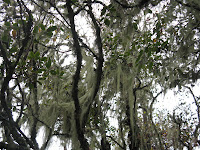
From Khumjung, we walked through rhododendron forests where the lichens hung from the trees like giant spiders' webs.
 We arrived at the lodge in the early afternoon. We were surprised that our room had an ensuite bathroom. The shower did not work, the water in the tap was cold and the toilet sistern leaked, but heh, this was luxury! The weather has turned extremely cold, but my wonderful down sleeping bag kept me snug and warm during a rather noisy night. There were rats gnawing behind the wooden partitions and we kept thinking they were were coming into the room.
It rained all day today and there were no views of the mountains at all!

The monastery at Khumjung is 300 years old. It contains, what is said to be, a yeti skull. Truly bizarre!


From Khumjung, we walked through rhododendron forests where the lichens hung from the trees like giant spiders' webs.

Phakding to Namche Bazaar
The lodge at Phakding was very pleasant. After an early start, 6.30 'knock, knock' and 'bed tea' (that means wake up call and tea in bed!), we headed downhill to the river. Crossing the river entailed walking across a metal bridge which sways backwards and forwards and side to side.

As always, masses of downhill is followed by a huge climb. Unfortunately, poor weather prevented us from seeing our first view of Everest, but we did see our first snowy peaks.
Namche Bazaar is a pretty Sherpa village perched on the sides of the mountains. It is full of shops selling climbing gear and just about anything else that you might want to buy.

Namche Bazaar is the Headquarters of Sagarmatha National Park. Sagarmatha is the Nepalese name for Mount Everest. Everest is the name of the British surveyor who discovered it was the highest mountain in the world. The Tibetan name for Sagarmatha is Chomolungma.
 Namche is at 3440 metres and usually, an extra day is spent here to acclimatise to the altitude. We were not able to do this as we were one day behind schedule.
 So far, so good. No symptoms of altitude sickness and am managing to keep up with the younger people in the group.

As always, masses of downhill is followed by a huge climb. Unfortunately, poor weather prevented us from seeing our first view of Everest, but we did see our first snowy peaks.
Namche Bazaar is a pretty Sherpa village perched on the sides of the mountains. It is full of shops selling climbing gear and just about anything else that you might want to buy.

Namche Bazaar is the Headquarters of Sagarmatha National Park. Sagarmatha is the Nepalese name for Mount Everest. Everest is the name of the British surveyor who discovered it was the highest mountain in the world. The Tibetan name for Sagarmatha is Chomolungma.


Monday, 1 November 2010
The trek to Phakding

We landed at Lukla and could immediately feel the effects of the altitude. Any physical effort resulted in breathlessness. Fortunately, we do not have to carry our own luggage. We have four dzhos (animals that are a cross between a yak and a cow), to do the heavy work.
Lukla is our first experience of Sherpa country. It is a scruffy town. Chickens and cockerels wander freely in and out of the shops. Horses and dzhos meander along the street leaving their 'calling cards' at regular intervals. Prayer flags are hung between the houses and shops and the sound of yak bells warn of the approach of animals with long curling horns.
We walk towards Phakding in the dark, passing prayer walls which have to be circled in an anti-clockwise direction.

A member of our group, manages to walk off the path down the side of the mountain. Fortnately, his fall is broken by trees and shrubs and he escapes with cuts and scratches.

The flight to Lukla
Hurrah! The weather is good and we can fly out of Kathmandu. After what seemed like an endless wait, we boarded the tiny 20 seater aeroplane. I was lucky enough to sit right behind the pilots.

The plane flies right between the mountains. Barnaby and several of the passengers were too scared to look even though the cloudy weather made the mountains seem less threatening.

The runway at Lukla is the size of a football pitch so the pilots have to get the landing just right or the plane hits the wall at the far side of the runway. One plane was involved in just such an 'incident' a few days ago and we saw it with a bandaged 'nose' being repaired on the runway.

The plane flies right between the mountains. Barnaby and several of the passengers were too scared to look even though the cloudy weather made the mountains seem less threatening.

The runway at Lukla is the size of a football pitch so the pilots have to get the landing just right or the plane hits the wall at the far side of the runway. One plane was involved in just such an 'incident' a few days ago and we saw it with a bandaged 'nose' being repaired on the runway.
Kathmandu Again!
Due to poor weather in Lukla over the last three days, a large backlog of passengers meant we were unable to fly out of Kathmandu.
Having wasted most of the day waiting to see if we would be able to fly, we made made the most of what was left of the day by visiting another Durbar Square in a different part of the city called Patan.

As it is a Hindu holiday, the children are not at school. They are spending their free time flying small paper kites. The sky is filled with brightly coloured, fluttering kites and the children are trying to 'win' kites by making their friends' kites hit the ground.
Having wasted most of the day waiting to see if we would be able to fly, we made made the most of what was left of the day by visiting another Durbar Square in a different part of the city called Patan.

As it is a Hindu holiday, the children are not at school. They are spending their free time flying small paper kites. The sky is filled with brightly coloured, fluttering kites and the children are trying to 'win' kites by making their friends' kites hit the ground.
Subscribe to:
Posts (Atom)